Tuesday, July 10, 2012

C.S. Lewis


Author and Oxford alum C. S. Lewis said this about literature:

"In reading literature one becomes a thousand men and women and yet remains oneself.  Like a night sky in the Greek poem, I see with a myriad eyes, but it is still I who see.  Here, as in worship, in love, in moral action, and in knowing, I transcend myself and am never more myself than when I do."

Please Bookmark Me!

If you are interested in my blog, I would love if you would bookmark this page!  I plan to post almost daily now through when I return from Oxford.

Thursday, July 5, 2012

Class at Oxford

Reading Twentieth Century Poetry

Above is a link to the course description of the class I'll be taking at Oxford.  I'll be leaving Milwaukee for England the night of August 2nd and class starts on August 5th!

Museum of the North: History of Painting


Museum of the North

The Museum of the North in Fairbanks, Alaska, has an interesting gallery dedicated to the idea of Perspectives.  In the gallery, regular citizens, not museum curators, were asked to write an analysis of a piece of art and their analyses were paired with the paintings and sculptures they described.  A hiker, for example, wrote an analysis of a painting of a mountain.  A doctor wrote an analysis of a female nude.  This type of analysis where a non-expert is asked to say something engaging about a piece of art directly relates to what I will be doing with my students at the Milwaukee Art Museum this fall.  We can all learn to see more in a piece when we sit down and take time to "read" it.


Great Piece of Turf


Albrecht Durer was a German artist, the first non-Italian to be considered a "celebrity" during the Renaissance.  Durer (like Leonardo da Vinci) believed that sight was the most important sense that humans have.  He believed in finding beauty in every day or even ugly things.  In his painting, Great Piece of Turf (1503), he presents an ordinary patch of grass as something beautiful.  Botanists today have been able to recognize all of the plant and grass varieties present in the painting.  Durer believed that if a painter tried to improve upon nature in his work, he would not often succeed (Gardner 507).


Perspective

Bottom of the Mountain

Top of the Mountain

22 days to the start of the Olympic Games in London!

Tuesday, July 3, 2012

Words of Wisdom


Observations of Nature

My family visited Wrangell-St. Elias National Park in Alaska yesterday, one of the most remote national parks in the country.  While in the Visitors' Center, I found a book I had to buy.  It is by Clare Walker Leslie and Charles E. Roth and it is called Keeping a Nature Journal, but it is the subtitle that caught my attention:  "Discover a Whole New Way of Seeing the World Around You."   Discovering new ways of seeing is the focus of my AP English class for the fall!  The book has a lot of great ideas for exercises that I can do with my students to help us to analyze, sketch, and write about the world around us through close observation. One of my ideas is to take the class outside to do some close nature observations in the school courtyard, and then perhaps read poetry on topics relating to nature by Mary Oliver.

Keeping a Nature Journal: Discover a Whole New Way of Seeing the World Around You

SIGHT SEE ing

On Saturday, my husband and I took a 12 hour bus tour of Denali National Park.  I became very aware of my overarching theme for my AP English class next year of Seeing and Looking.  As we scanned the lush tundra, we were able to see grizzly bears, moose, caribou, a snowshoe hare, and more.  The mountains were breathtaking.


Another topic I reflected more on during the bus tour was Perspective and the many connotations of the word.  Our bus driver told us that Denali National Park is so big that if a person were to explore 1,000 acres of the park every day, it would take 16 years to explore the whole place!  His comment put the vastness of the park into perspective for me.

Tuesday, June 26, 2012

Detour: Alaska!

Now that I'm working on this project, I am finding art everywhere!  I am currently in Anchorage, Alaska, on a family vacation.

Beautiful pillar in the Seattle Airport

Fred Machetanz's Quest for Avuk (1973) at the Anchorage Museum


Sydney Laurence's Arctic King (1925)  Laurence is considered one of Alaska's best landscape painters.

The Atrium of the Anchorage Museum

My son, Ben, inside the jawbones of a juvenile whale

This whale skeleton struck me as Art.  What do you think?

Ben creating his own art at the Alaska Native Heritage Center

Totem Pole at the Alaska Native Heritage Center.  Totem poles tell stories; you "read" them from the top down.

Saturday, June 23, 2012

Olympic Art


http://www.posterlounge.co.uk/london-2012-olympics-swimming-pr63012.html

http://www.dezeen.com/2011/11/04/london-2012-olympic-and-paralympic-games-posters/

Countdown!

34 days until the Opening Ceremonies of the London 2012 Olympics--that means 39 days
until I leave for England!


Friday, June 22, 2012

Rubens's Allegory

 Peter Paul Rubens's Allegory of the Consequences of War (1638-9)

Being an English teacher, I often have to deal with the issue of not having an exact answer for what a work means. We can do a close reading of a text, focusing on every detail, deciphering diction, and distinguishing tone to come up with an analysis, but unless an author has left an explicit explanation of exactly what he or she had in mind, we are often left to come up with our own interpretation.

In the case of Peter Paul Rubens' Allegory of the Outbreak of War (1638), Rubens wrote a letter that explained exactly what he had in mind when he was painting. Every figure represents an idea. The central figure of the work is Mars, the Roman god of war who rushes forward with a shield and blood-stained sword, ignoring his mistress Venus and the Cupid/ Amor figures who dance around her. Monsters personifying Pestilence and Famine represent the terrible by-products of War. There is a woman with a broken lute who represents Harmony being shattered, and a cast-aside olive branch shows that there is no hope for Peace. There is a frightened mother with her child, showing that the Future is threatened.

To the left of Mars is a grief-stricken woman with a torn veil. The woman represents Europe, showing what war has done to the continent. (From 1562-1721, there were only four years that all of the countries of Europe were in a state of peace instead of war.)

(Gardner 555)
 

Thursday, June 21, 2012

Velazquez's Ideas About Seeing, Looking, Being Seen


Diego Velazquez is considered the greatest Spanish painter of the Baroque era.  In his most famous painting, he addresses issues relating to seeing.  What do we see in mirrors, in paintings, in "real" space?  In pictures within pictures?


Velazquez's Las Meninas (1656)

The Gist Effect

One of the reasons why I originally designed this project is because too often I have visited art museums and galleries, looked at paintings, and thought: "Nice colors."  "Yep, there's a painting of flowers."  "Oh yeah, I've heard of that guy."

Too often I looked at a painting for about ten seconds, felt like I got the gist of it, and moved on.  I knew that there was more to analyzing a piece of art, but I was not sure what that was.  I think that many of my students feel that way about poetry.  Oh, okay, this poem is about a tree.  That's nice.

Tonight when I was studying Caravaggio's Entombment for my Art History class, I thought about how in the past I would have just thought, Oh, another religious painting.  That's nice.  Next.  I am finding it really interesting to learn more about the historical contexts of many paintings and why they were significant during the time they were painted and why they are significant today.
Caravaggio's Entombment (1603)

Entombment is known for its contrast of light and dark colors and the way it invites viewers to participate in the scene presented.  Historically, this painting is significant because it was created during the time when the Catholic Church was defending itself against the Protestant Reformation.  This painting was put in place above an altar in a Catholic church in Rome, so that it created the illusion that Christ's body was being laid down upon the altar.  The painting was a symbol of the Catholic belief of transubstantiation, that Christ literally gave up his body to be shared as the Eucharist.

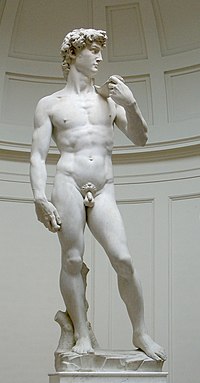
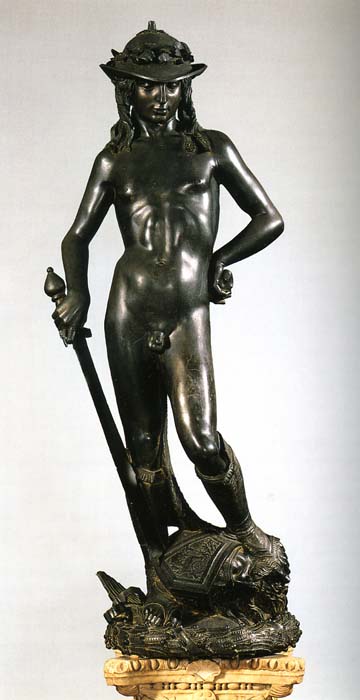
David


Michelangelo's David (1501)
Bernini's David (1623)
Donatello's David (~1430-40)

Monday, June 18, 2012

Leonardo's Perspective

Leonardo da Vinci's La Scapigliata (1500)
Leonardo da Vinci believed that sight is our most important sense.  He believed that "reality in an absolute sense was inaccessible and that humans could only know it through its changing images.  He considered the eyes the most vital organs and sight the most essential function.  Better to be deaf than blind, he argued, because through the eyes individuals could grasp reality most directly and profoundly"  (Gardner 458).

Saturday, June 16, 2012

Symbolism in Painting

Jan van Eyck's Giovanni Arnolfini and His Bride (1434)  

Paintings in northern Europe in the 15th century were often imbued with symbolism.  In Jan van Eyck's Giovanni Arnolfini and His Bride, we see a newly married couple holding hands.  It is, however, easy to miss some objects that were included in this painting very purposefully to be symbolic.  For example, a dog is in the painting to allude to the fidelity of the couple (dogs being known for their loyalty), the cast aside clogs indicate that the couple stands on sanctified ground, there is a statue of St. Margaret who is the patron saint of childbirth, and there is also a whisk broom to serve as a symbol of domestic care.

Source: 
Gardner, Helen, and Fred S. Kleiner. Gardner's Art through the Ages: The Western Perspective. Australia: Wadsworth/Cengage Learning, 2010. Print.

Allegory in Painting

Ambrogio Lorenzetti's Peaceful Country (1338-9)
Allegory is a useful term in an English class.  Essentially, it means that there are two levels of meaning that can be interpreted by reading a story:  the literal story that is being told as well as a secondary level of meaning that is implied.  For example, Arthur Miller's play The Crucible is very literally about the Salem Witch Trials of 1692.  There is, however, another level of meaning where Miller is asking his readers to look around and see the many other cases in life where we accuse people of something that isn't true without finding out all the facts first.  Miller wrote the play during the 1950s and was making a connection to the accusations of people being Communists that were prevalent during the McCarthy era.

Above, I have included a painting called Peaceful Country that was painted by Ambrogio Lorenzetti in 1338-1339.  The work is at its most literal a depiction of a peaceful rural scene.  There are rolling hills in the background, peasants work in plowed farmlands, several people ride through on horseback.  The allegorical level of the painting is implied by the figure in the upper left hand corner.  This figure represents Security, promising safety to those who live harmoniously under the rule of law.

Friday, June 15, 2012

Te Pehi Kupe

These images caught my attention in the introduction of my Art History textbook.  On the left is a painting called Portrait of Te Pehi Kupe (1826) by an Englishman named John Henry Sylvester.  Te Pehi Kupe was a man from New Zealand who was visiting England to gather arms to take back home.  On the right is a self- portrait created by Te Pehi Kupe.  We see that in his self-portrait Te Pehi Kupe presents himself through a flat representation of his tattoos.  Te Pehi Kupe was a chieftan and his tattoos represented his status.  The text notes that Te Pehi Kupe created his self-portrait without the use of a mirror to accurately depict his tattoos.  

I plan to use these images when our class reads Chinua Achebe's Things Fall Apart, and we talk about the idea of multiple perspectives.  There are so many different ways among the world's cultures to perceive ourselves and others; I think these works of art will create an interesting starting point for discussion.

ART 183

I have started my online Art History course through the University of Wisconsin--Waukesha.  I was happy to look through the syllabus and the textbook and see that this class focuses on exactly what I want to be learning about to advance my project.  Each week, we read a chapter in Gardner's Art Through the Ages: The Western Perspective.  We define terms and movements and make notes on a set list of images that we are given ahead of time.  The class also requires four exams and four essays.  From time to time, I will post different images that I think I will be able to use in the classroom in the fall.